
Point Load Test
Overview
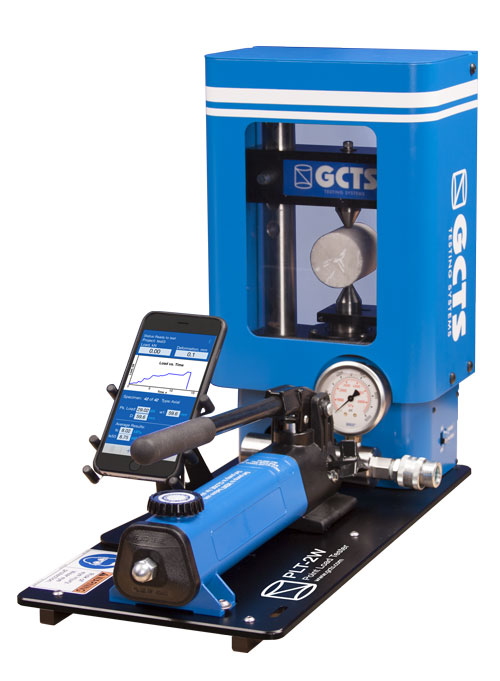
The Point Load Test, also known as the Point Load Strength Index Test, is used to calculate the rock strength index of a rock specimen. From the rock strength index, other rock parameters, such as the uniaxial compressive strength, can be estimated. This test is very economical due to the simplicity of the apparatus and the minimal amount of required materials to execute. It is an excellent alternative for the uniaxial compression test because it does not require significant specimen preparation or extensive testing, thus it is not time-consuming and results are seen relatively quickly. Data collected from the point load test can then be used to make quicker and more informed decisions during exploration phases in a very cost-effective and time-efficient method. A point load testing apparatus, such as the one depicted to the right, is ideal for quick testing in the field. They are typically portable and wireless, thus allowing the user to perform multiple tests without the need of outlets or an external energy source. These testing systems often are able to perform other tests in addition to the point load test. These include: brazilian (indirect tension) test, unconfined compression test, and ultrasonic velocity
How is the Point Load Test Performed?
To determine the point load strength index of a rock, a specimen is simply subjected to an increasingly concentrated load until failure occurs. Failure occurs in this test when the rock specimen has been split. The load is applied in a concentrated manner using two coaxial, conical platens. The load at which the specimen fails can be used to calculate the point load strength index. This calculated strength index can be used to classify the rocks being tested.
What Does a Point Load Test Specimen Look Like?
A typical test specimen should not be less 30 mm (1.18 in.) and no more than 85 mm (3.35 in.) in diameter. The preferred diameter for a point load test is about 50 mm (1.97 in.). The specimen typically does not require any specific preparation; however, the specimen should not have any abrupt irregularities that can generate stress concentrations. If there are any abrupt irregularities, they should be removed with a rock saw or a chisel. There are no specifications for the shape of the specimen, as diametral, axial, block, and irregular shapes may be used.
How are Rock Characteristics Determined?
After performing the point load test, the maximum load the specimen was able to resist before failure can be found. By taking this maximum load and dividing by the equivalent core diameter squared, the uncorrected point load strength index is determined. The equivalent core diameter squared is equal to the diameter squared for a diametral core test and equal to four times the area divided by pi for axial, block, and lump tests. To determine the approximate uniaxial compressive strength, the uncorrected point load strength index is multiplied by an index- to-strength conversion factor (which depends on a site-specific correlation between the uniaxial compressive strength and the uncorrected point load strength index or as given by a generalized table provided by ASTM).
What are the Trade Offs of the Point Load Test?
The point load test offers two major advantages over similar tests. First, the point load test is a relatively cheap test, as the system required to perform the test is not very large or complicated. The point load test does not require specialized specimen preparation, thus eliminating the need for other expensive equipment in order to prepare a specimen. This test is also relatively rapid and yields a test result rather quickly. This allows for quick, informed decisions to be made. Also, this test can be performed in the field, thus enhancing efficiency.
Although the point load test can be performed quickly, it only provides an index and an estimate for the uniaxial compressive strength. It does not provide the accuracy and detailed characteristics of a rock specimen like other similar tests (such as the rock triaxial test). Therefore, point load test results are never recommended for design or analytical purposes.
Keywords: Point Load — Concentrated Load — Rock Strength Index — Uniaxial Compressive Strength — Point Load Testing System — Point Load Strength Index — Rock Point Load Test
© 2016 Geotechnical Consulting and Testing Systems, LLC. All Rights Reserved.
- ASTM D5731 - Standard Rock Point Load Strength Index
- ASTM D7012 - Standard Test Methods for Compressive Strength and Elastic Moduli
- ASTM D3967 - Standard Method for Splitting Tensile Strength
- ASTM E10 - Standard Method for Brinell Hardness
- ISRM Determining Point Load Strength
- ISRM Determining the Uniaxial Compressive Strength of Rock Materials
- ISRM Determining Indirect Tensile Strength by the Brazil Test